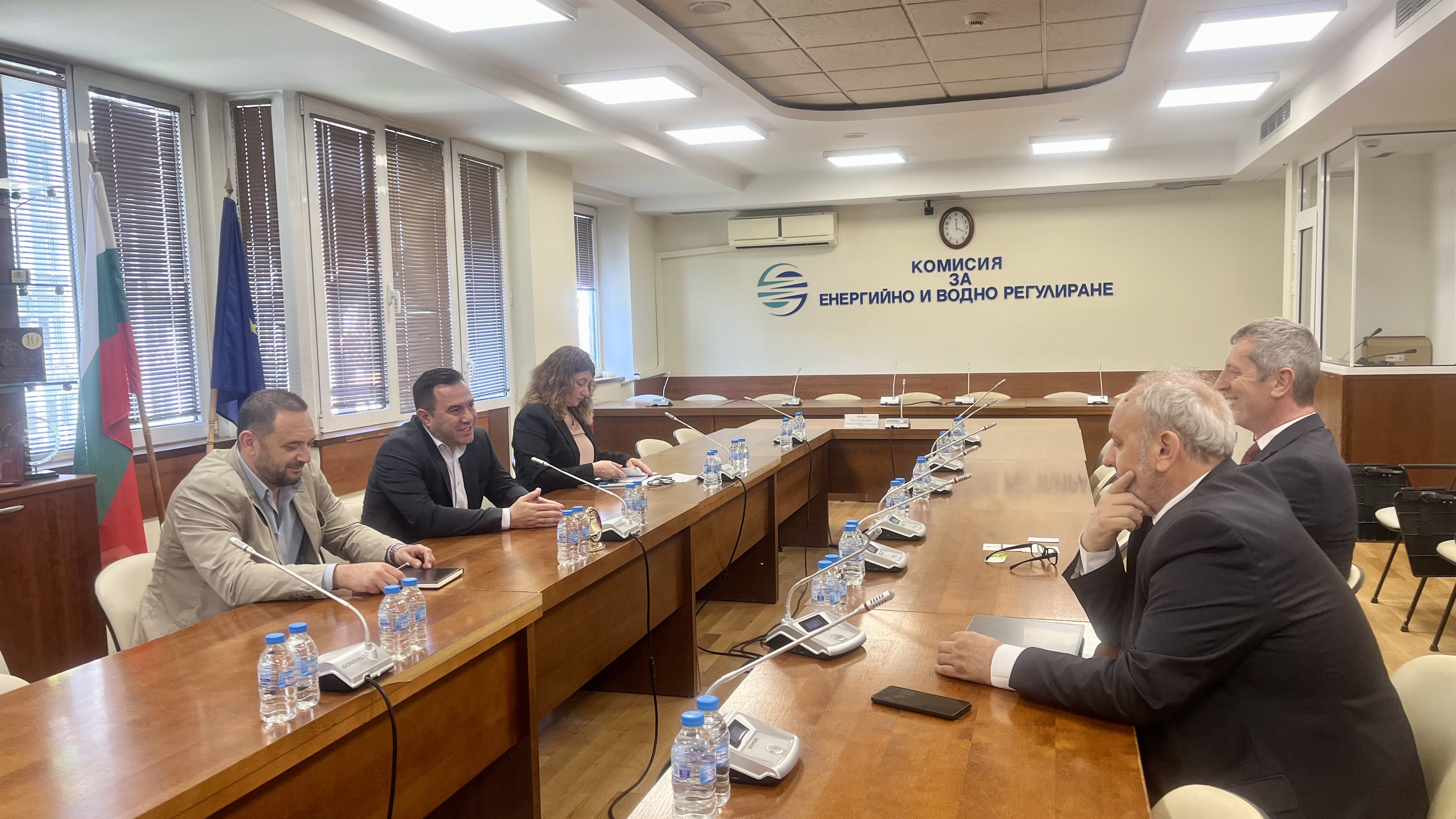
EWRC Chairman met with the Vice-President of the Council of European Energy Regulators (CEER)
The role of European regulators in implementing successful policies in the context of the Green Transition and decarbonisation of economies was discussed today by EWRC Chairman Plamen Mladenovski and the Vice-President of the Council of European Energy Regulators (CEER) Dietmar Preinstorfer. The meeting took place at EWRC premises ahead of their participation as speakers in the Green Transition Forum 5.0 - a key event for green innovation and sustainability in Central and Eastern Europe. EWRC member Dimitar Kochkov also joined the discussions.
The CEER Vice President, responsible for relations with regulators from Eastern and South-eastern Europe, emphasized that the current visit to our country was his first visit after being elected at the position last month. He introduced EWRC Chair to the main highlights of the upcoming CEER meetings, which will mark the 25th anniversary of the organization and outlined its general strategy for the next 5 years. In this regard, Dietmar Preinstorfer expressed confidence that the Bulgarian energy regulator will take an active part in the upcoming discussions.
EWRC Chairman Plamen Mladenovski emphasized the important role of cooperation between regulators in the region in formulating joint solutions in the field of energy transition to green economies, improving the interconnection of the electricity and natural gas markets, and achieving acceptable power exchange prices. The Bulgarian regulator is determined to give new impetus to the work of the Balkan Advisory Forum, established at the initiative of EWRC in 2018. "The Forum has become a successful platform for the exchange of good regulatory practices on a wide range of issues of common interest. This motivates the Bulgarian energy and water regulator to come up with specific initiatives and an action plan to activate the work of the Forum as soon as possible," emphasized Plamen Mladenovski.
EWRC Chairman and CEER Vice-President expressed a common view that decarbonisation is a process without an alternative, but its accelerated implementation is associated with the provision of significant financial resources, which has a high social cost. For this reason, countries should take gradual steps and decarbonisation at this stage should be a priority in the transport and household sectors, and at the next stage, a breakthrough should be sought in the field of industry.


